Find change points efficiently in exponentially distributed data
Source:R/fastcpd.R
fastcpd_exponential.Rdfastcpd_exponential() and fastcpd.exponential() are
wrapper functions of fastcpd() to find changes in the rate of
exponentially distributed data, i.e. mean change under exponentially
distributed noise (cf. changepoint::cpt.meanvar with
test.stat = "Exponential"). The function is similar to
fastcpd() except that the data is by default a matrix or data frame or
a vector with each row / element as an observation and thus a formula is
not required here.
Arguments
- data
A matrix, a data frame or a vector.
- ...
Other arguments passed to
fastcpd(), for example,segment_count.
Value
A fastcpd object.
Examples
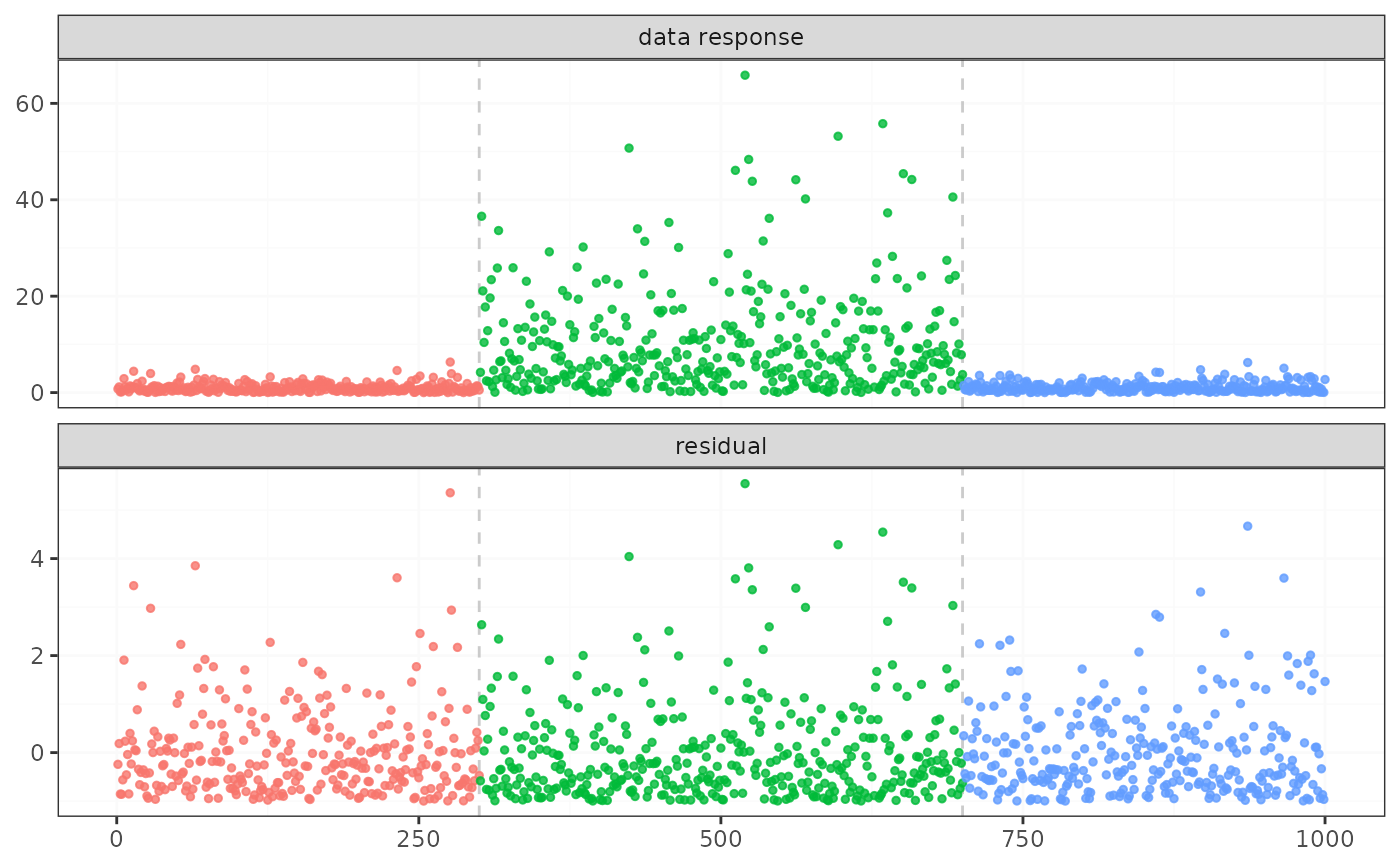
set.seed(1)
data <- matrix(c(
  rexp(300, rate = 1),
  rexp(400, rate = 0.1),
  rexp(300, rate = 1)
))
system.time(result <- fastcpd.exponential(data))
#>    user  system elapsed
#>   0.002   0.000   0.002
summary(result)
#>
#> Call:
#> fastcpd.exponential(data = data)
#>
#> Change points:
#> 300 700
#>
#> Cost values:
#> 301.6378 1326.448 331.5256
#>
#> Parameters:
#>   segment 1  segment 2 segment 3
#> 1  1.004055 0.09939726 0.9088465
plot(result)